



Agentic AI is transforming the industrial ecosystem by shifting software from passive dashboards to active, autonomous problem-solving workforces. Using tools like the Mendix Platform, manufacturers are now orchestrating human and AI collaboration, which builds essential data silos across engineering departments, shop floors, and supply chains.
Traditional industrial software waits for a human to look at the metrics, translate the chart into what that means for the business, and trigger a solution. With the rise of agentic apps, this dynamic changes completely as AI agents execute multi-step workflows like root cause analysis or dynamic schedule adjustments without requiring a manual handoff.
Additionally, platforms like the Mendix Agents Kit simplify the process by allowing domain experts to build safe automation logic quickly and efficiently. By moving away from the traditional approach, industries can trade complex database joins and custom API maintenance for a shared context via the Enterprise Knowledge Graph and MCP.
What is new in Mendix
In the ever-changing world of AI, it’s helpful to stay on top of the latest tools that are available. Back in October 2025, Mendix announced a significant platform release including extensive AI capabilities to meet the growing demand for agentic applications.
Key additions to our toolkit include:
- Agent builder & agent kits: Build task-specific AI Agents within Mendix Studio Pro with drag-and-drop components in a visually friendly interface rather than manually writing complex custom code.
- Agentic workflow orchestration: Create the link between human workers and AI agents within a long-running, governed, end-to-end execution process.
- Model context protocol (MCP): Expose and consume enterprise data securely, allowing the AI agents a standardized fabric to interact with external systems.
- MAIA assistance: Leverage Mendix’s embedded generative AI assistant to handle multi-step development, app theming, and navigation setup through simple conversation.
You can learn more about these tools here
Connecting the industrial digital thread
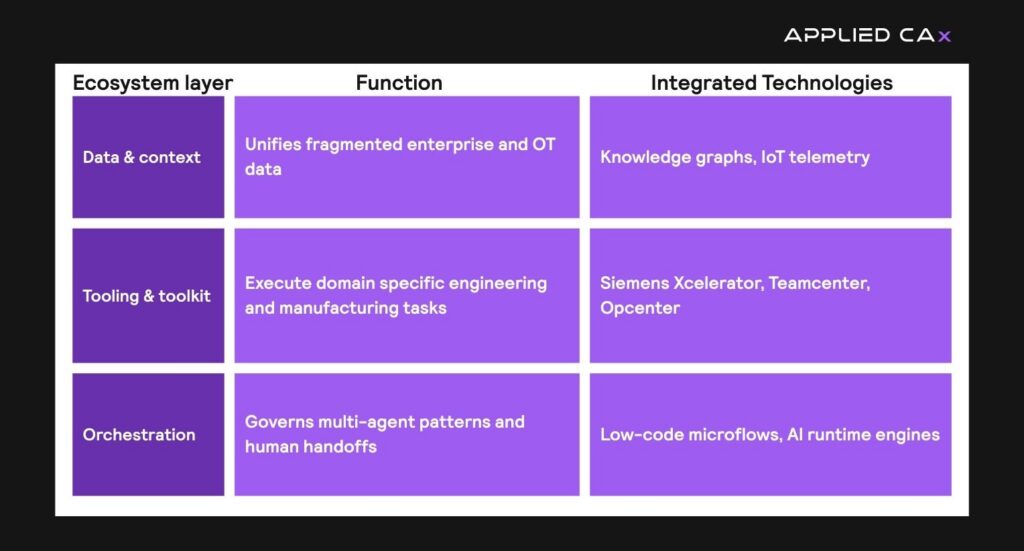
Industrial Ecosystems rely on continuous data flow between product lifecycle tools, IoT sensors, and resource planning systems. Mendix acts as the orchestration layer connecting these diverse environments.
The challenges of Agentic AI
Like any new technology, there are a few things to be cautious about before implementing Agentic AI into your business. The financial investment, skill gaps, and ethical concerns can keep many innovation plans trapped in their planning stages.
While the technology promises savings in the long term, the upfront investment is a considerable undertaking. If your business is lacking in-house AI experts, investments will be required in training, resources, and the initial infrastructure. Forecasting the operational costs will also help avoid unexpected expenses.
In many ways, AI is evolving faster than most can keep pace with. From ‘predictive’ to ‘generative’ to the newest ‘agentic,’ it seems a new type of AI technology pops up every few months, promising to be better than the last, and businesses are struggling to keep up with the skill gap. While 75% of companies are adopting some sort of AI, only 35% of workers have received even basic AI training. This has been keeping many organizations years away from implementing agentic AI strategies.
Giving a machine the power to analyze data and act without checking every step with a human first raises ethical concerns about accountability. Who will be held responsible for issues when they occur? The business owner, the technology, or the programmer? These are questions that must be answered before implanting autonomous technology.
Now that the challenges have been addressed, let’s weigh them against the potential benefits brought to the table.
Driving real-world value
The orchestration layer assists manufacturers and industrial operations that struggle with disconnected data living across their systems. This allows them to move past simple chatbot interfaces and start deploying autonomous digital teammates that target high-impact scenarios.
- Predictive maintenance: Automatically correlate sensor anomalies with service histories to dispatch technicians to work before equipment fails.
- Non-convergence (NC) detection: Continuously monitor for defects and deviations on shop floors to enable real-time responses to quality control issues before they affect additional products.
- Supply chain resilience: Dynamically reroute components when a supplier bottleneck occurs by cross-referencing real-time logistics data. By allowing autonomous background monitoring, concerns are met with immediate 24/7 responses rather than needing to wait for manual input.
- Design optimization: Assist engineers through natural language interactions to refine component blueprints based on desired performance, manufacturing constraints, and lightweight, cost-effective materials.
- Data protection: Address the rising concerns for cybersecurity by preventing uncontrolled chatbot queries and data leaks by applying governed guardrails with human-in-the-loop checkpoints.
Interested in how Mendix fits into your workflows? Contact us.
By Emily Dederick
Software Engineer at Applied CAx